

Nature-Informed Material Thinking: Reflections on Materials Innovation at HIT

עודכן: 17 בפבר׳
Reflections and a lecture, exploring nature, materials, design, and technology in the age of AI and human–machine interaction. Following the "(a) Matter of Time" symposium at Holon Institute of Technology (HIT)
Designing in Technological Environments and the Biological Human
When we speak today about design in technological environments, the discussion often moves between human–machine interaction, intelligent systems, and artificial intelligence, and very basic, physical, everyday experiences: body, sensation, learning, and response. Even in a digital, algorithm-driven era, humans remain biological beings—responding to materiality, touch, weight, heat, and rhythm, and interpreting technology through their own senses and intuition.
Within this tension that exists between the material and the digital, the "(a) Matter of Time: Matter and Anti-Matter" symposium took place as part of the MA program in Design for Technological Environments at HIT, beautifully curated by Dr. Naama Giladi. The symposium included my lecture, Nature-Informed Material Thinking, which opened the materials session.

When Materials and Technologies Are Still Taking Shape
Beyond changing existing conditions, I see equal importance in intervening at the stage when materials, technologies, or material applications are still emerging. At this point, before things become fixed by market demands, regulation, or habitual use, there is still meaningful space to ask questions and to examine environmental, social, cultural, and ethical implications.
This is where Nature-Informed Material Thinking operates as a systematic and practical framework for material innovation; one that understands materials not as neutral substances, but as active participants within ecological, cultural, and technological systems.
This applies to the rapidly growing field of biological and biosynthetic materials, as well as to new production methods, more conventional commercial materials, and advanced or nanomaterials. From my work and research, which move between practice and theoretical discourse on materials, I repeatedly encounter a gap between the pace of technological and material development and the tools we have to think through their broader implications.
When decisions regarding production, implementation, applications, and end-of-life scenarios are left solely to those who develop and commercialize the technology, large-scale “silent failures” can emerge. Expanding the decision-making space to include perspectives capable of systemic, contextual thinking is therefore critical.
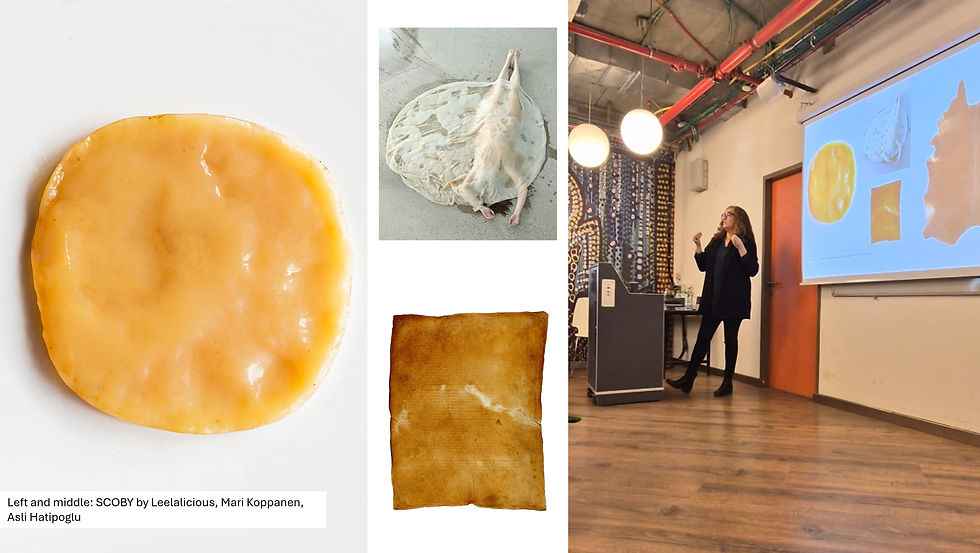
Nature-Informed Material Thinking: The Role of Designers
In this context, designers occupy a unique position of influence. They operate within complex systems that connect humans, materials, technology, industry, and culture. Designers do not replace engineers, researchers, or regulators, but through design thinking they act as mediators and translators, holding together considerations of function, experience, and meaning.
Within the dialogue between matter (physical reality) and anti-matter (digital reality), sensitive mediation is required between what is technologically possible and how things are actually experienced, perceived, and adopted. After all, humans remain biological beings, with intuitions and habits that do not evolve at the same pace as technology. This is where, in my view, design thinking and material knowledge intersect.

Why Not to Replicate Nature: Authenticity in a Digital Age
Another theme that emerged during the symposium relates to a tension that exists both in human–machine interaction and AI-driven technologies, and in the physical, material, and emotional world. This tension arises from attempts to create organic or natural sensations through systems that are not organic.
Digital systems operate according to systematic, mathematical, and consistent logic, while biological humans (and natural systems more broadly) develop through inconsistency, mutation, and deviation. This gap becomes especially evident when technologies seek physical expression: the material interfaces that give them a body tend to remain rigid, standardized, and familiar, even when the technology itself is described as “sensitive” or “intelligent.”
The challenge, in my view, is not to replicate nature through technological means, but to recognize the limits of imitation and, in parallel, to develop alternative materials, experiences, and interfaces; ones that can be authentic to the new kinds of experiences they create.
Materials Innovation as a Bridge to the Future
Meetings such as this symposium sharpen, for me, the importance of genuine interdisciplinary dialogue. Not dialogue that attempts to replicate existing solutions through new tools, but one that examines what becomes possible when material, technology, and human experience are considered together as part of a single system.
For me, materials innovation is not only about solving existing problems. From the earliest stages of development and design, it helps chart future decisions by taking environmental, social, cultural, and ethical responsibility seriously. At this point, design knowledge can function as a bridge between emerging technologies and real human lives: biological, complex, and deeply material.
(a) Matter of Time symposium Lectures and Speakers:
Dr. Naama Giladi
From Digital to Material – A Reverse Engineering Narrative
Closing remarks: The Designer as Mediator – Material and Anti-Material
Dr. Hadas Lorber
“Responsibility Matters”: Ethics, Governance, and Human Responsibility in the Age of Autonomy and AI
Prof. Oren Zuckerman
Embodiment: Interaction Between Human, Technology, Material and Body
Ms. Efrat Barak
Nature-Informed Material Thinking
Dr. Amit Zoran
Beyond the Boundary of Imagination: On Love and Healing Between Human, Machine and Wood
Ms. Maya Ben David
Intangible Matter
Interested in materials innovation? Please feel free to contact us and receive information about lectures, consulting and research services, and follow for updates on everything interesting happening in the field.