
Articles
I'm a title. Click here to edit me.

Material Innovation: Spider Silk, Fashion, and the Shift from Science to Industry
Recently, Balenciaga’s Spring 2026 collection received unusual attention beyond the world of fashion, appearing in scientific and financial publications. While the collection itself was launched several months earlier, the renewed discussion does not focus on the collection as a whole, but rather on a specific material used in a few of its pieces: spider silk. The time gap between the runway presentation and the later scientific coverage offers a useful entry point into understanding how material innovation כיום moves between the lab, industry, and the market. The material in question is a protein produced through a biotechnological process by the company AMSilk, inspired by spider silk. At Balenciaga, it is used in several satin garments. In headlines, it is often referred to as “spider silk,” but the official description is more precise and cautious: a biologically engineered protein fiber, produced through a unique fermentation process and derived from renewable resources. This gap between headline and technical description is not merely a matter of wording, but part of how new materials enter broader discourse. Spider webs are not uniform. Different species weave webs with diverse structures and techniques, which are used primarily for capturing prey. One familiar example is the circular web spun by the Orb Spider. Spider Silk as a Material: Why Is It So Compelling? Spider silk has long captured the imagination beyond the realms of science and nature. From "David and the Spider" to Spider-Man, these fine, almost invisible threads are widely associated with a unique combination of delicacy and strength, often described as being stronger than steel. Over time, these qualities have turned spider silk into a symbol of an “ideal” material, one that seems to reconcile properties that usually come at the expense of one another. Spider silk is a protein-based material that mimics natural spider fibers and is considered one of the most intriguing subjects in material research and innovation. Natural spider silk combines high tensile strength with elasticity, and in some cases, remarkable energy absorption. This combination points to significant application potential across industries, from textiles and architecture to medicine and aerospace. As such, spider silk has been a key driver of biomimicry research worldwide for decades. However, producing spider silk for human use has proven to be far from straightforward. In theory, one could harvest silk from wild spiders or farm them for fiber production and create wonderful exemplars. In practice, unlike silkworms, which have been domesticated for thousands of years, spiders cannot be easily farmed. They are small, territorial, and often cannibalistic, making large-scale production unfeasible. A spider silk cape made from hand-collected webs from millions of spiders in Madagascar. An extraordinary project that illustrates the material's potential alongside the impracticability of industrial-scale production. First exhibited at the V&A in 2012. Credit: Matthew X Bird, from Wikipedia, licensed under CC BY-SA 4.0. Edited from source. There is also an ethical dimension. The traditional silk industry relies on silkworms that are killed during fiber extraction, a practice increasingly questioned in recent years, partly due to the rise of vegan movements. As a result, spider silk-inspired proteins are sometimes presented as a vegan alternative to conventional silk, although questions remain regarding the environmental and ethical implications of their production processes. Together, these factors mean that the attempt to create “spider silk-inspired” fibers reflects both the exceptional properties of the material and the biological limitations that drive technological solutions. From Protein to Fiber: The Challenge of Biotechnological Production In nature, spider silk begins as a protein solution inside the spider’s body, which passes through a spinning gland and solidifies into a fiber upon contact with air. During this process, factors such as concentration, pH, and mechanical stress change, enabling the proteins to organize into a structure that gives the fiber its unique properties. In biotechnological production, it is possible to replicate similar protein sequences. However, the main challenge lies in transforming these proteins into continuous, functional fibers. Over the years, attempts to produce long fibers with stable internal structures, a key requirement for achieving comparable mechanical properties, have met with only partial success. It is also important to remember that this is ultimately a textile. The transition from material to fiber, from fiber to yarn, and from yarn to fabric involves multiple processing stages, each influencing the final result. Even if the starting material is similar, the way it is spun, woven, or finished determines its behavior. Sheep wool offers a useful comparison: the same material can be processed into dense felt, coarse fabrics, or fine textiles, while remaining fundamentally the same fiber. Silk-satin fabric: Silk is a natural protein fiber produced by animals, usually silkworms, while satin is a type of weave that creates a smooth, shiny appearance. Silk can also appear in other weaves and finishes, such as wild silk, and satin can be made from different types of fibers. Promise vs. Reality: The Long Road to Commercial Production Over the years, several companies have attempted to develop fibers inspired by spider silk, including Spiber, AMSilk, and the Israeli company Seevix, each approaching the challenge from a different angle. Spiber’s projects illustrate key turning points in the field. Their early blue dress, presented in 2013, marked a significant milestone in producing fibers through industrial methods and demonstrating real textile applications. However, it did not exhibit exceptional properties and received limited exposure. Later, the Moon Parka, developed in collaboration with The North Face, became a landmark example of material and technological development in fashion. Its textile properties were tailored to meet performance requirements for outdoor wear. Although presented as a commercial product, it was produced in very limited quantities, serving primarily as a demonstration of technological progress. Interestingly, over time, Spiber shifted away from explicitly positioning its work as spider silk-inspired and instead developed a broader protein platform under the name Brewed Protein. This now underpins a range of collaborations with fashion brands. This trajectory is not unique; many startups developing biomimetic or bio-inspired materials undergo a similar process of aligning their initial vision with the realities of development, production, cost, and market demand. Spider Silk in Fashion: Balenciaga and AMSilk as a Case Study What makes the Balenciaga case particularly interesting is that these are not purely demonstrative pieces, but products available for purchase, albeit with an important caveat. In January 2026, AMSilk presented its collaboration with Balenciaga as the introduction of its material into commercially available products, and Kering, Balenciaga’s parent company, confirmed that two items in the collection incorporate this material. The caveat lies in the product details. For example, one item is composed of 65% silk and 35% protein fiber. In other words, these are not garments made entirely from the new material, but hybrids combining traditional silk with biotechnologically produced fibers. This distinction is crucial for understanding both the material and the product. This development is part of a broader pattern of collaboration between startups developing innovative and often more sustainable materials and fashion brands, particularly in the luxury sector. This sector is characterized by smaller production volumes, higher price points, and a greater openness to experimentation, making it a suitable testing ground for new materials. In such collaborations, the product is often part of the development process rather than its final outcome. It is also worth noting that AMSilk’s work extends beyond textiles. The company has developed additional applications for its proteins, including cosmetics and textile coatings. This highlights a key characteristic of biosynthetic materials: they are not inherently tied to a single industry but can move across multiple domains. Screenshot from the Balenciaga product page, showing the material composition (65% silk, 35% protein fiber). Credit: Balenciaga.com (screenshot) Between Inspiration and Application: Changes in the Material Along the Way One of the central material questions raised by this case concerns the gap between the properties associated with the natural inspiration and those present in the manufactured version. Spider silk is known for its exceptional mechanical properties, yet, as seen in early Spiber garments and likely in the current Balenciaga pieces, these properties may be only partially realized, if at all. However, this gap is not necessarily a loss. As materials move from nature to the lab, and from there to production and products, they change. The process involves adjustments, compromises, and sometimes unexpected discoveries. In some cases, these changes reveal properties or applications that were not part of the original promise. In this sense, the question is not only whether the material “lives up to expectations,” but how it performs within the system in which it is used. Spider silk is another example from the field of biomimicry that is not about direct replication of nature, but about translating its principles. As in many other cases, nature provides the initial spark, but does not dictate the final outcome. From a systems perspective, the transitions between science, industry, and design are processes in which materials evolve, adapt, and sometimes diverge from their original concept. This divergence is not a flaw, but often a source of innovation in its own right. Perhaps this is where the broader value of developing new materials lies: not only in what they promise at the outset, but in what they enable us to discover along the way. Interested in materials innovation? Please feel free to contact us and receive information about lectures, consulting and research services, and follow for updates on everything interesting happening in the field.

Harnessing Design Thinking Methods for Material Innovation
Material innovation is often framed as the search for new substances or improved performance. In practice, it is a much broader challenge that sits at the intersection of material properties, user behavior, production systems, and market realities. It requires not only scientific knowledge, but the ability to understand how materials operate within complex, real-world contexts. This perspective shifts the focus from isolated material development to a more strategic, systems-oriented approach, where materials are understood as part of larger technological, cultural, and economic frameworks. This becomes especially relevant when working across design, science, and industry, including in contexts such as Israeli material innovation, where close collaboration between disciplines is essential. Exploring Innovative Design Thinking Methods in Material Innovation Design thinking is often associated with product design or user experience, but its principles become particularly valuable when applied to materials. Not as a fixed process, but as a way to structure exploration, connect disciplines, and move between abstract ideas and tangible outcomes. For example, NakedPak, a startup founded by industrial designer Naama Nicotra, began as a graduation project and developed into a system where packaging becomes part of the product itself. The material is designed to dissolve and cook with the meal, redefining the relationship between packaging, product, and use. This startup was also presented in one of my recent lectures on material innovation, where, alongside the curiosity it sparked, questions arose around hygiene and taste. In the discussion that followed, it became clear that the ability to rinse the material before cooking, together with positive feedback from early users, reflects how material decisions take shape within everyday practices. These decisions enable new possibilities that respond to user needs and reduce the environmental impact of eating. NakedPak: packaging that becomes part of the meal, dissolving during cooking. Also featured in my recent lecture on material innovation. In material innovation, design thinking often takes the form of concrete working methods: Cross-disciplinary collaboration: Material development rarely happens within a single discipline. It requires the integration of scientific knowledge, an understanding of manufacturing processes, and a design perspective that considers use, context, and value.
Rapid prototyping and iterative testing: Unlike digital systems, material experimentation requires physical iteration. Prototyping is slower, more resource-intensive, and carries consequences that cannot be instantly reversed.
Scenario-based thinking: Materials exist within specific contexts of use. Considering where and how a material will be applied helps surface constraints early, from manufacturing processes to user interaction and long-term maintenance.
Sustainability mapping: Assessing a material across its lifecycle reveals trade-offs that are not always visible at the development stage. Decisions made at the level of sourcing or processing often carry long-term environmental and social implications. In , founded by chemist Michael Layani, designers are involved from early stages, shaping applications alongside material development. Their role is not only aesthetic, but instrumental in translating material potential into market-relevant products. Companies like Daika Wood demonstrates how these principles take shape in practice. The company has developed an innovative material based on wood waste that behaves like wood but can be produced through casting and 3D printing, enabling new applications. From early stages, designers were part of the team, helping translate material potential into relevant uses within real-world systems. Daika Wood: wood waste transformed into a castable material for new applications. Challenges as Opportunities in Applying Design Thinking to Materials Material development often begins with an open, exploratory mindset, where the goal is to expand possibilities rather than define them. Only later do constraints become central, not as limitations, but as tools for navigating complexity and making informed decisions within real-world systems. Complexity: The world of materials is vast, with countless variations of each. Navigating it requires more than scientific knowledge; it demands the ability to see the bigger picture. Long development cycles: Unlike digital products, materials take time. Development can span months or years of testing, iteration, and validation, where each decision has physical consequences that cannot be instantly reversed. Cost alignment: Material choices are not made in isolation. The cost of a material must align with the pricing of the final product and the broader business model, shaping what is feasible at scale. Sustainability trade-offs: Evaluating materials across their lifecycle reveals system-level interactions that are not always visible during development. Decisions at the level of raw materials and processing carry long-term environmental, economic, social, and regulatory implications, shaped by both market dynamics and policy frameworks. Taken together, these approaches—cross-disciplinary collaboration, iterative prototyping, scenario-based thinking, and sustainability mapping—become visible in real material developments. UBQ Materials, for example, converts unsorted household waste into a usable industrial material, addressing one of the key limitations of current recycling systems: the need for sorting. Beyond the technological solution, this approach operates within an existing system, shaped by policy, market conditions, and the way materials are perceived and adopted in practice. Having worked with UBQ Materials in the past in the context of material curation material curation in design and innovation, and having followed their development over time, it becomes clear that material innovation is shaped not only by technological capabilities, but also by the systems in which materials operate. UBQ Materials: converting unsorted household waste into industrial material. Moving Forward with Strategic Material Innovation Material innovation today requires more than technical expertise. It calls for the ability to connect material properties with user needs, production realities, and long-term environmental impact. Across different contexts, from early-stage initiatives like NakedPak to industrial-scale solutions such as UBQ Materials, and material-driven companies like Daika Wood, material innovation reveals a consistent pattern. The success of a material is not determined by performance alone, but by how it is integrated into systems of production, use, and value. This requires a shift in perspective, from treating materials as isolated substances to understanding them as part of interconnected systems. This shift is not only methodological, but strategic. It shapes how materials are developed, evaluated, and ultimately adopted. Interested in materials innovation? Please feel free to contact us and receive information about lectures, consulting and research services, and follow for updates on everything interesting happening in the field.

Indigo, Denim and Authenticity: Material Value in a Global System
From Natural Indigo to Global Denim: A Material Choice That Became a Cultural Phenomenon Jeans are one of the most recognizable garments of the twentieth century, strongly associated with American culture. Yet their origin was entirely functional. Denim, woven in a cotton twill structure, offered a precise combination of durability and flexibility suitable for miners, farmers and industrial workers. Dyeing it with indigo was not an aesthetic decision but a material one. Indigo bonded well with cotton, performed relatively well under sunlight and repeated washing, and was available in quantities compatible with industrial production. These were critical considerations in a rapidly industrializing world, long before jeans became symbols of rebellion or personal style. The story of indigo and denim, however, is not merely about fabric and color. It is a case study in how a technical material decision evolves into a cultural and economic phenomenon. Through a single material, we can read an entire system: relationships between technology and production, between culture and market power, between time and value. A close-up of twill weave in denim, you can clearly see the diagonal line and the difference between the two blue and light weft threads. Long before it became synonymous with denim, natural indigo was a globally traded pigment with a deep history. It was used to dye textiles across Asia, Africa and the Middle East for thousands of years, embedded in trade networks and layered with cultural and ritual meanings. In Japan, the tradition of indigo dyeing known as Aizome developed centuries before denim appeared. This tradition relies on agricultural knowledge, fermentation processes and embodied expertise passed down through generations. It is material knowledge built through time and contact, not abstract information. When denim entered Japan in the late nineteenth century, and more significantly after World War II through American presence, it encountered a culture already grounded in deep material literacy. While denim in the West underwent rapid industrialization and mass production, Japan developed a parallel denim culture rooted in existing shuttle looms, slower processes and preserved craftsmanship. Rather than rejecting industrialization, it articulated an alternative within it, one where value was measured in time, process precision and intimate familiarity with the material. In today’s global market saturated with imitation, this commitment to time and process has become a distinctive value proposition. A Japanese Selvedge denim close-up. Source: Bless Denim Fading and Technology: When Precision Systems Attempt to Produce Imperfection To understand why denim ages so distinctively, we need to examine the technology behind it. In the rope dyeing process, warp yarns are dyed with indigo before weaving. Unlike many other dyes, indigo does not penetrate deeply into the fiber but adheres primarily to its outer layer. The result is a yarn that is dark on the outside and lighter at its core. Once woven in a twill structure, the fabric becomes two-toned and responds uniquely to friction. Each fold, movement and abrasion gradually removes a thin layer of dye, revealing the lighter core beneath. Fading is irregular and unpredictable. It records a specific body over a specific time. Originally, this was not a design feature but a by-product of material behavior in physical labor. As denim transitioned into large-scale industrial production, natural fading became a challenge. New garments appeared too uniform, too untouched, disconnected from the rugged narrative already attached to jeans. The industry responded with various techniques to simulate wear. Early methods included pumice stones, oxidizing agents and sandblasting. More recently, laser and ozone technologies have improved control over water consumption and pattern repetition. Yet even advanced systems are not fully automated. Zones, intensities and repetition patterns are deliberately defined. In premium and luxury segments, manual finishing is still applied to disrupt symmetry and introduce controlled irregularities. Precision is engineered first, then selectively undone. Comparison: New jeans (left) vs. worn jeans after years of use (right) This paradox has accompanied the denim industry for decades. After enormous scientific and economic effort to synthesize indigo and standardize production at scale, further resources are invested to reintroduce signs of time, use and irregularity. The system excels at repetition and control, yet recognizes that cultural value lies precisely in what resists uniformity. Engineered Authenticity and Material Value: Relationships, Time and Professional Responsibility The tension revealed through denim reflects a broader pattern. Systems optimized for economic efficiency and serial production produce precise, accessible products at scale. Yet the very success of this model generates homogeneity that weakens perceived depth and uniqueness. Instead of transforming its structural logic, the system often attempts to manufacture authenticity within it, not by reconnecting with origins but by engineering the appearance of connection. New jeans that have been hand- and laser-etched: The etching reveals the white hue within the fiber (right) and in the weft threads (left). It attempts to mimic natural etching but ends up with a strong, replicated, and uniform line. Material value does not arise solely from physical properties. It emerges from the system in which the material operates. In its simplest form: Material value = relationships + time. When time is removed or relationships are severed, the product may remain functional or even luxurious, but part of its meaning is lost. Attempting to restore meaning without restoring relationships produces simulation. The recent case of Kolhapuri sandals presented by Prada illustrates this tension. The design drew directly from traditional leather sandals produced for centuries in Kolhapur, India, within a living craft system embedded in local knowledge and economy. When a luxury brand releases a near-identical version at a vastly higher price point, the issue is not merely formal resemblance. The shape remains, but the relationships that generated its value, local craftsmanship, cultural continuity and regional economic context, are removed. The sandal migrates from a system of lived practice into one of branding and constructed scarcity. Left: Kolhapuri chappals in a roadside shop, Kolhapur, India. Photo: सुबोध कुलकर्णी. Center: Kolhapuri chappals, Kolhapur, India, late 20th century Bata Shoe Museum. Photo: Daderot. Right: Prada Men's Spring-Summer 2026 Collection. Photo from Instagram/@prada This is not a technical mistake but a systemic decision. Beyond cultural appropriation concerns, consumers are offered engineered authenticity detached from its source. Yet most people intuitively sense the difference between material that has accumulated time and relationships and material that merely imitates them. This perception is not romantic nostalgia but embodied understanding. What I call material literacy connects chemistry, production processes, lived use and cultural context into a coherent reading of systems. This is why innovation in materials cannot be reduced to technical performance alone. The question is not only how a material is made, but how to think about it within broader systems of people, technology, culture and environment. Without material literacy, decisions may be technically correct yet humanly flawed over time. When we begin to understand materials as participants in relational systems, responsibility inevitably follows. Interested in materials innovation? Please feel free to contact us and receive information about lectures, consulting and research services, and follow for updates on everything interesting happening in the field.

Nature-Informed Material Thinking: Reflections on Materials Innovation at HIT
Reflections and a lecture, exploring nature, materials, design, and technology in the age of AI and human–machine interaction. Following the "(a) Matter of Time" symposium at Holon Institute of Technology (HIT) Designing in Technological Environments and the Biological Human When we speak today about design in technological environments, the discussion often moves between human–machine interaction, intelligent systems, and artificial intelligence, and very basic, physical, everyday experiences: body, sensation, learning, and response. Even in a digital, algorithm-driven era, humans remain biological beings—responding to materiality, touch, weight, heat, and rhythm, and interpreting technology through their own senses and intuition. Within this tension that exists between the material and the digital, the "(a) Matter of Time: Matter and Anti-Matter" symposium took place as part of the MA program in Design for Technological Environments at HIT, beautifully curated by Dr. Naama Giladi. The symposium included my lecture, Nature-Informed Material Thinking, which opened the materials session. From Efrat Barak's lecture on "(a) Matter of Time: Matter and Anti-matter" of the Master's degree program in Design for a Technological Environment at HIT When Materials and Technologies Are Still Taking Shape Beyond changing existing conditions, I see equal importance in intervening at the stage when materials, technologies, or material applications are still emerging. At this point, before things become fixed by market demands, regulation, or habitual use, there is still meaningful space to ask questions and to examine environmental, social, cultural, and ethical implications. This is where Nature-Informed Material Thinking operates as a systematic and practical framework for material innovation; one that understands materials not as neutral substances, but as active participants within ecological, cultural, and technological systems. This applies to the rapidly growing field of biological and biosynthetic materials, as well as to new production methods, more conventional commercial materials, and advanced or nanomaterials. From my work and research, which move between practice and theoretical discourse on materials, I repeatedly encounter a gap between the pace of technological and material development and the tools we have to think through their broader implications. When decisions regarding production, implementation, applications, and end-of-life scenarios are left solely to those who develop and commercialize the technology, large-scale “silent failures” can emerge. Expanding the decision-making space to include perspectives capable of systemic, contextual thinking is therefore critical. From my lecture on "(a) Matter of Time: Matter and Anti-matter" of the Master's degree program in Design for a Technological Environment at HIT Nature-Informed Material Thinking: The Role of Designers In this context, designers occupy a unique position of influence. They operate within complex systems that connect humans, materials, technology, industry, and culture. Designers do not replace engineers, researchers, or regulators, but through design thinking they act as mediators and translators, holding together considerations of function, experience, and meaning. Within the dialogue between matter (physical reality) and anti-matter (digital reality), sensitive mediation is required between what is technologically possible and how things are actually experienced, perceived, and adopted. After all, humans remain biological beings, with intuitions and habits that do not evolve at the same pace as technology. This is where, in my view, design thinking and material knowledge intersect. From my lecture on "(a) Matter of Time: Matter and Antimatter" of the Master's degree program in Design for a Technological Environment at HIT Why Not to Replicate Nature: Authenticity in a Digital Age Another theme that emerged during the symposium relates to a tension that exists both in human–machine interaction and AI-driven technologies, and in the physical, material, and emotional world. This tension arises from attempts to create organic or natural sensations through systems that are not organic. Digital systems operate according to systematic, mathematical, and consistent logic, while biological humans (and natural systems more broadly) develop through inconsistency, mutation, and deviation. This gap becomes especially evident when technologies seek physical expression: the material interfaces that give them a body tend to remain rigid, standardized, and familiar, even when the technology itself is described as “sensitive” or “intelligent.” The challenge, in my view, is not to replicate nature through technological means, but to recognize the limits of imitation and, in parallel, to develop alternative materials, experiences, and interfaces; ones that can be authentic to the new kinds of experiences they create. Materials Innovation as a Bridge to the Future Meetings such as this symposium sharpen, for me, the importance of genuine interdisciplinary dialogue. Not dialogue that attempts to replicate existing solutions through new tools, but one that examines what becomes possible when material, technology, and human experience are considered together as part of a single system. For me, materials innovation is not only about solving existing problems. From the earliest stages of development and design, it helps chart future decisions by taking environmental, social, cultural, and ethical responsibility seriously. At this point, design knowledge can function as a bridge between emerging technologies and real human lives: biological, complex, and deeply material. (a) Matter of Time symposium Lectures and Speakers: Dr. Naama Giladi From Digital to Material – A Reverse Engineering Narrative Closing remarks: The Designer as Mediator – Material and Anti-Material Dr. Hadas Lorber “Responsibility Matters”: Ethics, Governance, and Human Responsibility in the Age of Autonomy and AI Prof. Oren Zuckerman Embodiment: Interaction Between Human, Technology, Material and Body Ms. Efrat Barak Nature-Informed Material Thinking Dr. Amit Zoran Beyond the Boundary of Imagination: On Love and Healing Between Human, Machine and Wood Ms. Maya Ben David Intangible Matter Interested in materials innovation? Please feel free to contact us and receive information about lectures, consulting and research services, and follow for updates on everything interesting happening in the field.
Reflective Materials: Glass Microspheres
How One Tiny Material Opens Up Big Questions Around Safety, Sports, Fashion, and Art A few years ago, I participated in a collaboration with the economic attaché of the Japanese Embassy in Israel. The goal was to create new connections between Japan’s manufacturing industry and potential clients in Israel in the field of materials. My role was to identify and manage contacts with Japanese companies. This professional adventure turned out to be both fascinating and enriching. Discovering Unique Materials As I launched into the project, I searched for companies producing unique materials that were either unknown in Israel or unfamiliar to the general professional public. I discovered a wide array of captivating materials and material technologies. These came from giant corporations to small family-owned factories and independent studios working in limited series. One of the most interesting materials I encountered was tiny, perfectly round glass beads produced by several major Japanese companies. Their most striking feature was their aesthetic and visual value. At that time I had no idea what they were used for, but their unique look sparked my curiosity. So I did what I always do with new and exciting materials: I began to investigate. I found that glass microspheres, or microbeads, have a wide range of applications, primarily related to their optical properties. They are often used in warning and directional signage due to their reflective qualities. I quickly realized these same beads are embedded in reflective films and sheets for protective clothing, such as those produced by 3M. In this case, the beads are embedded within a polymer matrix. A matrix, in this context, is the base material that holds all other components of a composite material. Think of it as a flexible structure with fillers added to alter its properties. In the case of 3M’s reflective sheets, the polymer matrix is embedded with glass microspheres that function as an optical additive. This gives the material entirely new functionality.
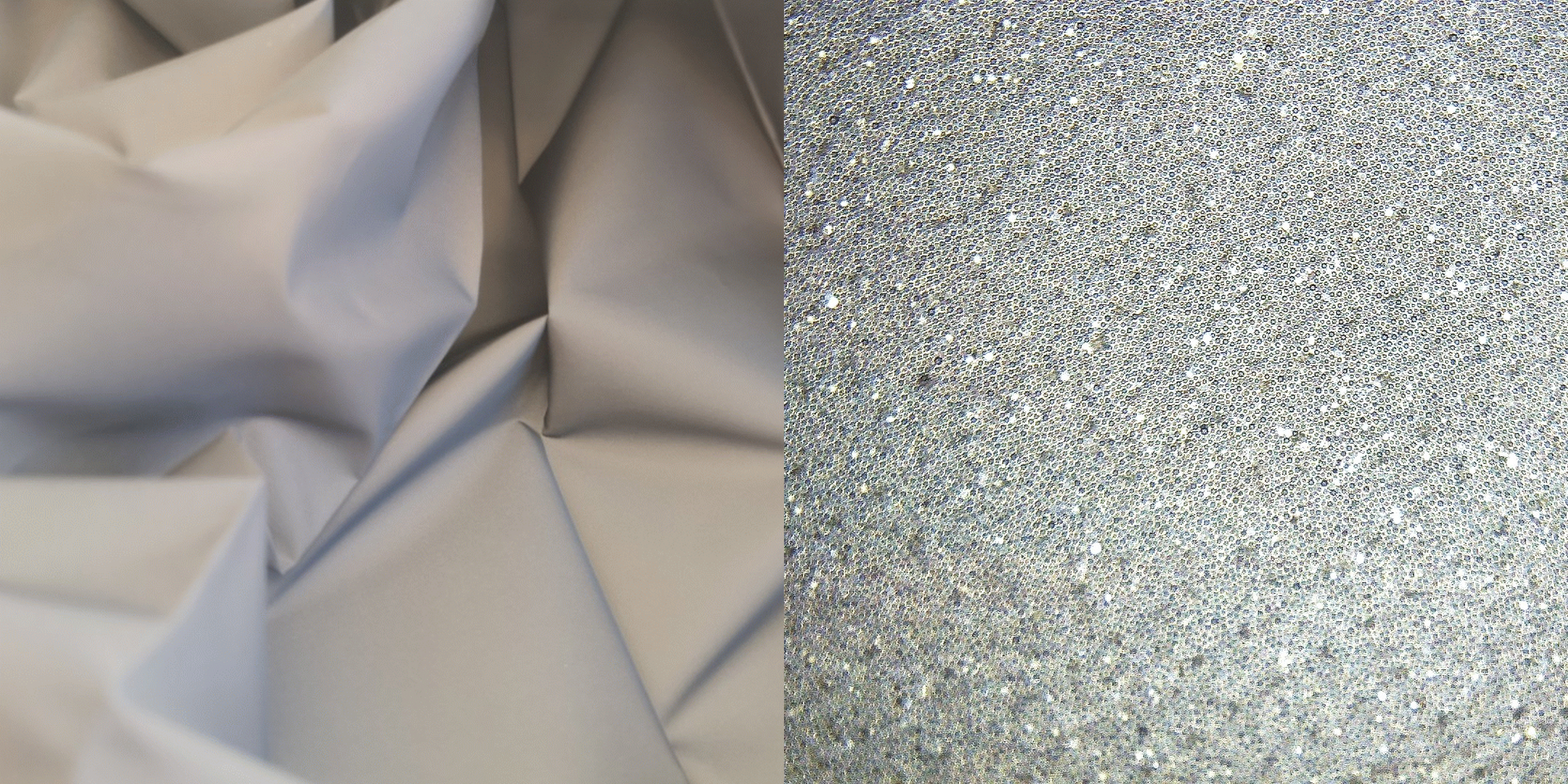
Thanks to their spherical structure, these beads produce a deeper, more intense reflectivity compared to flatter, more common, and cheaper particle fillers. Since then, these microspheres have joined the my mental encyclopedia of materials I work with daily. They appear now and then in interesting and surprising contexts. Here are just a few: Functional and Fashionable Wear In 2016, the studio ISHU launched the “Anti-Paparazzi Scarf.” This scarf is part of what the studio calls Anti-Flash Fashion Technology. It is printed with a reflective pattern that makes it almost impossible to photograph someone wearing it with a flash. More than just a functional or stylish item, the scarf received broad international coverage across fashion, entertainment, gossip, and even tech magazines. It’s a compelling case study that connects a new, market-available material with a smart design application, resulting in a simple, coherent and effective product story. This scarf marked a turning point where reflective materials became integral to fashion. From there, their use only grew. The “Anti-Paparazzi” scarf by ISHU Studio. Images from wccftech Major sportswear brands, like Adidas and Asics, now incorporate reflective films and prints containing microspheres in nearly all their products. These might appear in printed labels that simultaneously communicate brand info and increase wearer visibility. In high-performance sports shoes, the new material technologies allow for broader reflective coverage, embedded discreetly within flexible, colorful components that integrate seamlessly into the design. This remains hidden until illuminated. Anyone who runs or cycles alongside roads knows how important reflectivity is. But when responsibility lies 100% with the user, it doesn’t always happen. When materials and design make reflectivity an inherent feature, it becomes a natural and constant safety element rather than a task. It can save lives. Holabird Sports captured excellent photos demonstrating the effect of reflective materials in footwear Today, reflective materials in textiles are widely accessible. They are not just found in premium athletic gear but also from smaller brands. You can find lightweight reflective jackets, knit hats, reflective shoelaces, or iron-on patches for bags and clothes. These materials add aesthetic and especially functional value. Reflective Materials Matters: The big picture Material, technology, and design advancements have made today’s reflectives much more comfortable, lightweight, and attractive than they were 20–30 years ago. As a result, they’re now embedded in more and more products and have even become desirable in their own right. But this isn’t just about image or fashion. It addresses real safety needs arising from global trends. Over the past decades, the global population has grown steadily. Combined with urban density, this has led to crowded public spaces and increased interpersonal interactions. This raises new challenges for road safety and the need to identify objects and people in urban environments. At the same time, modern lifestyles have shifted from physically active work to screen-based jobs, with more car use and sedentary leisure activities. According to the World Health Organization (WHO), these lifestyle changes are a major contributor to chronic illness and declining quality of life. As a response, more people have adopted active habits, like leisure-time physical activity (LTPA), often in shared public spaces like parks and roads. This makes it crucial to design materials that meet aesthetic expectations, support activity, and also increase safety. Sports shoes and sneakers have become a standard choice for much of the population, not just for athletics Material Needs a Meaning As someone who has worked with materials for over a decade through a design lens, I know that understanding a material’s true meaning goes beyond technology or industry. Materials also operate in experiential, cultural, and aesthetic domains. They reflect values, stir emotions, and offer new ways to think, feel, and act. My first encounter with these glass beads left a visual impression long before I understood their practical potential. It was instinctive. That impression continues to echo in various artworks I’ve encountered where microspheres, either on their own or embedded in other materials, create poetic, emotional, or critical statements. Artworks often serve as platforms for material exploration that yield surprising results. Though they begin as artistic expressions, they sometimes lay the groundwork for new functional innovations. These discoveries might never reach industrial research. It’s a reminder that culture, in all its forms, isn’t a luxury but a core way we understand and shape the world. One of the most striking uses of glass beads in art is in internationally recognized artist Kohei Nawa’s PixCell series. In these sculptures, he coats taxidermy animals, everyday objects, and iconic figures with dense layers of glass spheres in varying sizes. Sometimes, synthetic resins are added to bind elements and enhance the sense of depth. From the PixCell series by Kohei Nawa. Photos (left to right): Scai The Bathhouse by Nobutada Omote – Sandwich, Designboom, Gyre Gallery This added layer transforms how we see the object beneath. The spheres act like miniature lenses that magnify, blur, or distort specific details. They make the original form disappear or re-emerge from a new angle. Nawa discusses how digital imagery culture alters our perception of biological forms and the need to reinterpret this hybrid reality. His work is also a tactile exploration of perception, distortion, and transformation. It shows how a basic material like glass can, through structure and application, render the familiar unfamiliar. From a practical standpoint, we can relate Nawa’s work to industrial uses of microscopic glass or multilayer coatings. These include safety films, reflectives, and smart vision tech. The difference is that Nawa isn’t guided by functional need but by the desire to generate sensory and conceptual experiences through material. From “Orpheus” by Uri Weinstein, exhibited at the Nahum Gutman Museum of Art. Photo: Yuval Yosef A more immediate, personal encounter with these microspheres came in Orpheus, an installation by Israeli artist Uri Weinstein, shown recently at the Nahum Gutman Museum. It featured near-human figures clad in robes made of reflective fabric. In normal lighting, the material appeared soft and gray. Under a camera flash, it lit up, canceling the rest of the scene. This heightened the tension between presence, technological mediation, and physical visibility. Weinstein’s choice of material powerfully illustrates how materials can provoke us. They change the way we see, move, and react. This type of reflective textile is often used in fashion and safety gear, like jackets and bags. It’s a special and versatile material that looks quite plain at first glance. A sample of it lives in my material collection, which I’ve built with one principle in mind: direct sensory experience is essential for understanding a material. Beyond technical data, what shapes our perception is physical interaction. This includes light play, texture, and the feedback a material gives. I even documented this textile through a microscope. The tiny beads embedded in the polymer matrix are clearly visible. From that angle, it’s easy to see why such materials spark interest in both creative and functional fields. Reflective textile from Efrat Barak’s material collection. Right: microscopic view Interested in materials innovation? Please feel free to contact us and receive information about lectures, consulting and research services, and follow for updates on everything interesting happening in the field.

Discovering Sustainable Material Solutions
In recent years, the urgency to rethink how materials are sourced, produced, and utilized has become undeniable. The environmental impact of traditional materials, combined with the growing demand for sustainable alternatives, has driven a wave of innovation in material science and design. As someone deeply engaged in this field, I find it fascinating how sustainable material solutions are not only addressing ecological concerns but also opening new avenues for creativity and strategic business growth. This exploration is particularly relevant for entrepreneurs, companies, students, academia, and organizations seeking to integrate design thinking with material innovation. The goal is to bridge design, science, and technology to create value that is both innovative and sustainable. In this post, I will share insights into the latest trends, practical examples, and strategic recommendations to help you navigate this evolving landscape. The Rise of Sustainable Material Solutions: A New Paradigm Sustainable material solutions are no longer a niche interest; they are becoming central to product development and innovation strategies worldwide. These solutions focus on reducing environmental impact through the entire lifecycle of materials - from extraction and manufacturing to use and end-of-life management. Key drivers behind this shift include: Resource scarcity: Finite natural resources push industries to seek renewable or recycled alternatives. Regulatory pressure: Almost all western governments are increasingly enforcing stricter environmental standards, the EU is the clear leader. Consumer awareness: Buyers demand transparency and sustainability in the products they choose. Technological advances: New methods enable the creation of materials with enhanced properties and lower footprints. Examples of sustainable materials gaining traction include bioplastics derived from plant-based sources, recycled composites, and innovative textiles made from agricultural waste. These materials often require rethinking traditional manufacturing processes and supply chains, which is where design thinking plays a crucial role. Plant and mycelium based biodegradable packaging. EB Material Collection Exploring Cutting-Edge Sustainable Material Solutions Innovation in sustainable materials is happening across multiple sectors, each with unique challenges and opportunities. Here are some notable examples: 1. Bio-based Polymers and Bioplastics Derived from renewable biomass such as corn starch, sugarcane, or algae, bio-based polymers offer a promising alternative to petroleum-based plastics. They can be biodegradable or designed for recycling, reducing plastic pollution significantly. Example:
Polylactic acid (PLA) is widely used in packaging, disposable items and 3D printing. Challenges:
Balancing performance with cost and scalability remains a hurdle.
Biodegrades in specific conditions, mainly industrial composting.
May contaminate recycling waste streams. 2. Recycled and Upcycled Materials Recycling materials like metals, glass, and plastics can reduce waste and energy consumption. Upcycling takes this further by transforming waste into higher-value products. Example:
Fashion brands using recycled ocean plastics to create textiles. Challenge:
Effective recycling requires robust collection systems and consumer participation. Insight:
Delivers even higher benefits in in-house or industrial-symbiosis scenarios. 3. Natural Fiber Composites Combining natural fibers such as hemp, flax, or jute with sustainable resins creates lightweight, strong composites used in automotive and construction industries. Benefit:
These composites are often biodegradable and have a lower carbon footprint than synthetic alternatives. Consideration:
Ensuring consistent quality and durability is essential for wider adoption. 4. Mycelium-Based Materials Mycelium, the root structure of fungi, can be grown into various shapes and used as packaging, insulation, or even furniture. Widely adopted in the filed of design material research and products. Advantage:
It is fully biodegradable and can be produced with minimal energy. Potential:
Mycelium materials are gaining attention for their versatility and sustainability. These examples illustrate how sustainable material solutions are not just about replacing one material with another but reimagining the entire material lifecycle and its interaction with design and technology. Sustainable materials developed by Israeli startups Anina (Left) Daika Wood (Right) Integrating Design Thinking with Material Innovation Design thinking is a user-centered approach that emphasizes empathy, experimentation, and iterative problem-solving. When applied to sustainable material innovation, it encourages looking beyond the material itself to consider the broader system - how materials are sourced, processed, used, and disposed of - and who and what do they effect. Here are some ways design thinking enhances sustainable material solutions: Empathy for users and environment:
Understanding the needs and impacts helps identify meaningful innovations. Prototyping with new materials:
Rapid experimentation allows testing material properties and user interactions. Cross-disciplinary collaboration:
Bringing together designers, scientists, engineers, and business strategists fosters holistic and successful solutions. Lifecycle perspective:
Considering the entire product journey ensures sustainability is embedded from the start to the end of the lifecycle. For example, a company developing packaging might use design thinking to explore how a new biodegradable material performs in various real-world scenarios, how consumers perceive it, and how it fits into existing recycling systems. This iterative process leads to more effective and user-friendly sustainable solutions. In my experience, combining design thinking with material science creates a powerful framework for innovation that is both practical and visionary. Practical Recommendations for Implementing Sustainable Materials Transitioning to sustainable materials requires strategic planning and a willingness to experiment. Here are actionable steps to guide this process: Assess Material Impact Conduct a thorough analysis of current materials’ environmental footprints, including sourcing, manufacturing, and disposal. Identify Suitable Alternatives Research emerging sustainable materials that align with your product requirements and values. Engage Stakeholders Early Collaborate with suppliers, designers, engineers, and end-users to understand constraints and opportunities. Prototype and Test Develop prototypes using new materials to evaluate performance, aesthetics, and user acceptance. Plan for Scalability Consider supply chain logistics, cost implications, and regulatory compliance for large-scale adoption. Educate and Communicate Share the benefits and challenges of sustainable materials with your team and customers to build support. Monitor and Iterate Continuously gather feedback and data to refine material choices and processes. By following these steps, organizations can reduce risks and maximize the benefits of sustainable material solutions. From Branding to Landscaping, there's a sustainable material solution for every business Embracing Sustainable Materials as a Strategic Advantage Sustainable material solutions are more than an environmental imperative; they represent a strategic opportunity for innovation and differentiation. By embracing these materials thoughtfully, organizations can: Enhance brand reputation and customer loyalty. Reduce costs through efficient resource use and waste reduction. Comply with evolving regulations and standards. Foster creativity and open new markets. The journey toward sustainability in materials is complex but rewarding. It demands curiosity, collaboration, and a willingness to challenge conventional practices. For those ready to engage deeply with this challenge, the rewards include not only environmental benefits but also lasting competitive advantage. In my work, I have seen how integrating sustainable materials with design thinking creates a fertile ground for breakthroughs. It is an exciting time to be part of this transformation, and I encourage all innovators to explore, experiment, and lead the way toward a more sustainable future. Interested in materials innovation? Please feel free to contact us and receive information about lectures, consulting and research services, and follow for updates on everything interesting happening in the field.

The Hive as a Model: Nature Inspired Material insight, from 3D Printing to Hand Wisdom
As someone who grew up working in an apiary (a bee farm), the golden hexagons of the honeycomb have fascinated me since childhood. Bees, as we know, build their homes from cells made of beeswax - a natural wax they produce in their bodies. This structure serves to store food, lay eggs, and raise the next generation. The honeycomb structure is neat and inspiring. The vast majority of the cells are built with precision and a fixed size. However, upon closer inspection, one can see that the structure is not rigid but flexible and adaptive. The construction varies according to the conditions and needs of the hive. For example, cells intended for raising males are larger, while cells at the edges may be smaller or asymmetrical. Walls can be thickened or thinned. Everything depends on the time, place, and purpose. The Hive: A System of Natural Design Years ago, during semester breaks while studying for my bachelor's degree in industrial design, I worked in an apiary. Slowly, I began to see the wonderful world of bees through a design, systemic, and industrial lens. I realized that the hive is a system created by natural design, combining high repeatability, in-depth familiarity, and economical use of material with high functional flexibility. This system is based not on centralized planning but on distributed intelligence - the result of synchronous action among many individuals responding to the environment in real time. Today, after completing a master's degree in environmental studies, my professional focus is on materials and material systems. My interpretation has deepened and expanded, incorporating a global-systemic and ecological perspective, familiarity with various human and biological systems, and knowledge grounded in scientific research from fields such as biology, environmental science, economics, policy, engineering, philosophy, psychology, and, of course, design thinking. Plastic honeycombs in the apiary where I worked. The article also includes a brief explanation of these hives and who developed them. Credit: Efrat Barak In retrospect, it seems that what the bees and the hive taught me is what we are striving to achieve today in the field of material innovation. This includes the development of multi-purpose applications and structures, compatibility between material and purpose, and the integration of local knowledge and needs with sustainable production capacity. In this sense, honeycomb does not only offer formal inspiration; it is the product of a dynamic biological system that provides new directions for both industrial and systemic developments. So, let's dive in! Biological 3D Printing One of the most fascinating aspects of the honeycomb structure is how it is built - a gradual process that occurs in layers, using a semi-liquid material that hardens and stabilizes. It's hard not to think of the similarity to 3D printing. Bees have demonstrated for millions of years what we can do today with advanced technology: planning based on methodology, adapting to local conditions, and responding in real time. The construction in the hive shows how it is possible to operate with high precision and repetition while maintaining flexibility. It is material-efficient, adaptable, can be disassembled and reassembled, and varies according to seasons, conditions, and space. The hive exemplifies a design mechanism that relies on a deep understanding of the relationship between material, need, and time. It is not a "one-size-fits-all solution" but a biological, living, and dynamic design that minimizes waste, maximizes resources, and adapts to a changing reality without harming the surrounding nature. Material, economic, and environmental efficiency is something humanity is only beginning to approach. A new study by Golnar Gharooni-Fard of the University of Colorado Boulder examined the strategies bees use to build honeycombs under different conditions. The researchers allowed bees to build on 3D-printed surfaces with hexagonal patterns of varying scales and identified three main strategies: tilting, merging, and layering. Israeli-American biophysicist and computer scientist Orit Peleg, one of the study's authors, explains that these strategies suggest an intuitive understanding of the physics involved in the collective construction process. Most importantly, the way bees build their hives is exceptionally adaptive. However, she notes that there is still much more to learn. Humans do not yet fully understand how bees construct their hives. Images showing two of the three bee building strategies identified in new research from the University of Colorado Boulder. Credit: Golnar Gharooni-Fard When I saw the printed surfaces used in this study, I was reminded of the plastic honeycomb developed by the late Yitzhak Ferman, a beloved teacher at Mikveh Israel and one of the founders of the honey industry in Israel. This unit is made of plastic, shaped like a reinforced frame that holds a surface with a three-dimensional hexagonal texture and a yellow color. This honeycomb is coated with wax so that it can be accepted by the bees, who will continue to build the cells with the wax they produce. Today, plastic combs have replaced the previous wooden combs, which were constructed from a wooden frame with metal wires stretched to hold a sheet of wax. Plastic combs offer durability and convenience in apiary work. Most interestingly, they can be reused for years, making them environmentally preferable in some cases. Yitzhak Ferman with the plastic honeycomb he developed. The plastic honeycomb with sealed honey cells and pollen cells underneath. Credit: Eitan Ferman A wooden honeycomb with honey cells and offspring cells underneath. Credit: The Volcani Center Recyclable Mono-material Construction If we try to learn from the material ecosystem of the hive, we will discover a system that exists almost entirely based on one material: wax. This multi-purpose structure - housing, raising offspring, storing food, etc. - is made from a material that is not industrial, not a product of mining, and not purchased or imported. Instead, it is produced locally, in the bodies of the bees themselves. They collect the raw materials, secrete the wax, process it, and build with it. Moreover, wax is not used just once, like most building materials we use. On the contrary, bees know how to disassemble, recycle, and rebuild with it repeatedly, depending on needs and conditions. If a hole needs to be plugged, wax will be applied. If expansion is required, a new layer will be added. If there are fewer bees, parts of the hive will be closed, and the material will be repurposed for other uses based on current requirements. In human contexts, this type of knowledge is referred to as "manual intelligence" or "material intelligence." These concepts have unique characteristics and potential that are crucial to recognize even today in our industrial-digital age. Examples of such wisdom in materials can be found in the article "First Lesson on Material Innovation" that I previously published here on the site. We can also learn about it from ongoing action research on the workshops of the Tel Aviv Kiryat Hamelacha, with results currently displayed at Beit Benyamini in the group exhibition "Material Intelligence" (curators: Yair Barak and Shira Shoval). However, it seems that in bees, this wisdom takes a step further. Wax is a substance that contains knowledge, a home, and the ability to respond to reality (adaptability) at the deepest level. This is not serial production of material as we know it in the modern world but rather emergent design that operates as part of an intelligent, living, and dynamic system. The Synthetic Apiary II project by Israeli-American researcher and designer Neri Oxman, along with the Mediated Matter group from MIT, sought to answer these and other questions. As part of the project, the group built a closed experimental environment that mimics natural climate conditions for bee habitation. This comprehensive project aimed to enable computerized monitoring and analysis of bee architecture to understand what structures they build and how they do so. One interesting observation from this project regarding beeswax was that bees would also use processed or additive-containing beeswax when available. Researchers speculate that bees do this because wax production requires a lot of energy, making it a more economical and efficient alternative. You can read more about the project and the fascinating worldviews behind it here, and here is an interesting interview with Oxman from that time, explaining the project at minute 14:25. Honeycomb structures created through collaboration between humans and bees, histograms of the honeycomb's structure, And cells built from wax with additives. From Synthetic Apiary II Credit: Neri Oxman and The Mediated Matter Group Nature Inspired Material, and Language In a world where supply chains are lengthening, raw materials are running out, and systems only function with contractors or external sources, the hive model offers a different idea. It suggests developing systems that allow for locally tailored implementation based on a limited variety of materials to enable flexibility, sustainability, and systemic well-being over time. Maybe instead of always hunting for the next groundbreaking nature inspired material, we should also pay attention for the language we use when working with materials. The hive also teaches us about a different relationship with matter - one based on familiarity and closeness. This relationship allows us to view matter not merely as a means of production but as a partner in the process. Bees know their matter intimately; they grow within it, live with it, and work with it throughout their lives. Their knowledge is material, sensory, and contemporary, allowing them to build and dismantle, adapt and change, without needing remote planning or operating instructions. This is true material-biological intelligence: wisdom arising from the encounter between body, matter, context, and environment. Such an understanding of matter can enable deeper, more precise innovation processes - ones based on mutual listening, gradual development, connection to local conditions, and the exercise of human, ecological, and ethical judgment. Instead of seeking solutions from outside, we can start from what already exists - in the system, in the environment, and in people. This applies to the development and application of materials, creative processes, and projects that seek to connect sustainability, technology, and culture. P.S. Speaking of bees, I'm always interested in seeing designers find new ways to look at the hive itself and use different configurations and materials. Take, for example, the final project of Yehuda Bar from the Department of Industrial Design at HIT. He found an original way to use mycelium, a very interesting and sustainable material, to build hives designed for urban agriculture. I met Yehuda even before he submitted the project when I came to advise the students in the department. I was very impressed by his knowledge and seriousness. No wonder that just after submission, the project called BEE2C is already on its next stage. Photo gallery from Yehuda Bar's BEE2C project Interested in materials innovation? Please feel free to contact us and receive information about lectures, consulting and research services, and follow for updates on everything interesting happening in the field.

Rethinking Materials: Insights from the IMD Symposium
Near Frankfurt, in a historic building that once housed a traditional porcelain factory, the IMD Materialdesign Designresearch Symposium took place. IMD, the Institute for Materialdesign and Advanced Material Studies, operates as part of HfG Offenbach. At first glance it looks like a small academic conference. In practice, it felt like entering a living research space, full of working hands, where cross-cultural encounters and interdisciplinary dialogue explore the future of materials from a design perspective. I arrived with a clear intention: to listen, to observe, and to understand what is currently happening in the leading academic hubs for material-related design and research in Europe. In the conference, organized by Prof. Dr. Markus Holzbach, Prof. Dr. Tom Bieling, Dr. Ziyu Zhou and Valentin Brück, I found a small, close-knit, welcoming professional community of material designers who work together in a spirit of openness, curiosity, and a desire to expand horizons through cross-disciplinary collaboration. Each comes from a different background and place – Germany, Italy, Colombia and more – a living network of shared practice, knowledge and passion for material design research. IMD: An academic institute inside a working porcelain factory The Höchst Porcelain Manufactory was founded in 1746 and still produces traditional handmade porcelain from local clay. The scale is modest, but the level of craftsmanship is among the highest in Europe. The factory has been operating for centuries, yet in recent years it has been struggling economically. This is the result of shifting tastes, competitive markets, and high production costs that are difficult to align with the demands of contemporary consumers. The presence of IMD inside the factory is no coincidence. Embedding an academic institute in this context is intended to preserve material knowledge, support local industry, and foster collaboration across generations and disciplines. Designers, researchers, and craftspeople work side by side, combining traditional knowledge with contemporary techniques, material research, and experimental tools for developing new materials. The physical setting of the symposium, surrounded by shelves of molds, prototypes, and tools, highlighted the direct connection between material, knowledge, community, and tradition. This is not only a place where materials are designed. It is a place that shapes and maintains culture and know-how. Collaboration between academia and traditional industry The Institute for Materialdesign and Advanced Material Studies (IMD) is a strong example of a direct connection between an academic institution and a traditional manufacturing environment. Similar models are emerging both within and beyond Europe, as part of new approaches to material development. These collaborations unfold at many interfaces: between design and the natural sciences, technology, sociology, and material culture. Designers work with biologists, chemists, mechanical and materials engineers, anthropologists, psychologists, medical professionals, and others. The shared understanding is that meaningful innovation in materials requires a systemic view and sensitivity to cultural and behavioral contexts. This type of collaboration allows for the preservation of unique traditional knowledge, while opening up new possibilities for research and development through cross-disciplinary partnerships and grounded, practice-based work. The symposium presented several initiatives in this spirit. Emma Sicher, for example, shared an interdisciplinary project with microbiology researchers from Humboldt University and Kasetsart University in Thailand. There she learned about local traditional fermentation techniques, which led her to discover that it is possible to grow SCOBY-like material systems from different sources without adding a starter culture. Combining traditional knowledge with design and scientific laboratories opened new research directions and questions that were previously out of reach. In Germany, the Matters of Activity (MoA) cluster at Humboldt University collaborates with the Max Planck Institute of Colloids and Interfaces on cross-disciplinary projects in design, biology, and soft-material chemistry. Johanna Hehemeyer-Cürten presented research into the properties, technologies, and potential applications of pine bark from local forestry. Her work focuses on the relationships between structure, material, and movement and on the potential of bark as an alternative resource. Sofia Soledad Duarte Poblete presented a compelling research project carried out at Politecnico di Milano within the Made Trans research group led by Prof. Valentina Rognoli. The project develops cross-disciplinary methodologies for working with local, culturally grounded, and sustainable materials, in collaboration with entrepreneurs, sustainability researchers, and materials scientists. In all these cases, collaboration between designers and researchers from other fields is not simply a nice-to-have support tool. It is a precondition for developing original, context-aware solutions that are grounded in systemic thinking. Rethinking Materials: Designers as drivers of innovation Throughout the symposium, one idea came up again and again. The role of designers in material research and development is broad and diverse. It is not limited to aesthetics. Designers build bridges between fields and help develop new material languages. Principles such as open-ended material exploration, listening to the material, hands-on practice, and iterative trial and error are now seen as core components of contemporary design research. They are also the practices that drive innovation through doing. In many of the research projects presented, designers took on the role of facilitators. They mediated between different disciplinary languages and helped create shared visual, material, and conceptual frameworks. In several cases, design research contributed to scientific discoveries on the one hand, and on the other to the communication and dissemination of scientific knowledge, thanks to the unique capabilities designers bring to the process. At the same time, an important insight emerged. For designers to integrate effectively into interdisciplinary research, they often need additional skills that are not always included in their formal education. These include systematic documentation, protocol writing, and quantitative measurement. Lacking these tools can slow down recognition of designers’ contributions, and sometimes even lead to unconscious dismissal by partners from other disciplines. If designers are to not only participate but truly influence, there is a need to strengthen their ability to communicate design processes and thinking in ways that scientific and technological partners can understand, appreciate, and use as a springboard for joint development. Working with scientists and engineers To develop innovative materials that are environmentally, technologically, and culturally relevant, design approaches or one-off craft experiments are not enough. The symposium clearly demonstrated how deep, long-term collaborations between designers, scientists, engineers, and environmental researchers can enable research breakthroughs, improve development processes, and help share and leverage scientific knowledge. Today, designers do not only “join” multidisciplinary teams. They actively initiate and orient their work toward domains that were previously considered “out of bounds”. They help rethinking materials by bringing their systemic thinking, contextual sensitivity, and the ability to imagine new material futures, which in turn attract interest from scientific partners. Alongside them, collaborators from scientific and engineering fields – chemists, biologists, mechanical and materials engineers – contribute theoretical and practical knowledge that supports the transition from exploratory work to scientific and applied discoveries. As presented in the symposium, many of these collaborations are made possible by international research frameworks supported by institutions such as the European Union, national research councils, or dedicated academic initiatives. Where institutional support exists, connections between design and science can move from one-off experiments to structured practice, leading not only to innovative projects, but also to deeper shifts in research and development culture. Environmental and ecological approaches to material design The connection between materials and sustainability is fundamental. Material use is one of the main ways in which human activity harms the planet. This happens through extraction, production, consumption, and disposal. It is a full cycle that includes mining finite resources, energy and water use, pollutant emissions, harmful working conditions, transport and packaging, and finally problematic end-of-life scenarios involving waste, pollution, and environmental and health risks. This is why there is growing recognition of the need to move away from an anthropocentric view, in which materials are seen only as tools to serve humans, and toward ecological and ecocentric perspectives. These see materials as part of broader systems of life, environment, time, and mutual relationships. At the symposium, this shift was not presented as an abstract theoretical move, but as concrete practice. Johanna Hehemeyer-Cürten offered a precise design interpretation of a statement attributed to Julian Vincent: “In nature, shape is cheap and material is expensive.” She compared how a single material in nature, such as cellulose, can be the basis for countless applications, forms, textures, and structures, with the way humans use countless materials, often sourced from all over the world, for a single application such as a smartphone. This comparison became a starting point for rethinking production systems, resource efficiency, and the intelligence embedded in natural systems compared with the excesses of human industry. Valentin Brück presented an ecocentric approach to material design that uses speculative design as a tool to imagine and plan desirable futures. His talk encapsulated a call that appeared in other lectures as well: expand the definition of “users” so that it includes not only humans, but also plants, bacteria, soil, and entire ecosystems. Only then can we build a foundation for sensitive, sustainable, systemic planning. From my perspective as a researcher and specialist in material innovation, this integration of sustainability and innovation is inseparable. It is not possible to design for the future without addressing the climate crisis, resource constraints, regulatory shifts, technological change, and geopolitical dynamics. Design that ignores these dimensions may appear innovative on the surface, but in practice it is planning for a future that will never arrive because it disregards the changing environmental, economic, and social realities. The potential in Israel Alongside what is happening in Europe, there is already an emerging foundation in Israel for material development grounded in design and sustainability. In research I conducted at Tel Aviv University, I found that around 11 percent of recent industrial design graduation projects focused on material development, and around half of those centered on environmental materials. Beyond the numbers, it is clear that design students are curious and eager to engage with environmental challenges through materials, though they usually do so intuitively, driven by personal motivation. This is precisely where a major opportunity lies. The potential connections between design and the natural sciences, engineering, environmental studies, local craft, and traditional industry have not yet been fully explored in Israel. Academia, accelerators, and local research institutes can build the infrastructure needed to elevate existing initiatives and create a broader, systemic, cross-disciplinary field of activity. There are already early signs of this future. We see new academic courses focused on materials from a design and interdisciplinary perspective, start-ups emerging from material-focused design graduation projects, and ad hoc collaborations between designers, architects, and researchers that generate new methods and scientific insights. These are the first shoots of a growing field. Given the growing global demand for alternative sources, technologies, and applications in the materials domain, a country like Israel, whose industry to date has focused mainly on a relatively narrow range of materials, can leverage its distinctive assets – excellent designers, curious researchers, a strong technology sector, and the well-known “Israeli mindset” – to become, if it chooses, a new hub for design-led material innovation. This would require building collaborations, knowledge infrastructures, and new development pathways. In conclusion The symposium sharpened something I recognize from my own practice. Innovation in the world of materials does not arise only from breakthrough technologies. It is also born in small labs and workshops, at the meeting points between disciplines, through curious investigation, hands-on work, and systemic thinking. I operate as an independent professional because I see a real need. Despite the genuine potential, the field in Israel is still in its early stages. Having worked in this space for more than a decade, I see it as important to translate and connect knowledge, between what is happening here and what is happening elsewhere in the world, and the other way around. My aim is to expose different audiences to emerging trends, connect designers, researchers, entrepreneurs, and industry partners, and help build a field that can generate professional, environmental, and economic value. I believe that in order to act differently, we first need to think differently, and to encounter examples that point us toward new directions. That is the first step. For me, this symposium was one such example, and I am glad to share some of the insights that came out of it. For more information about IMD – The Institute for Materialdesign and Advanced Material Studies: https://imd-materialdesign.com/](https://imd-materialdesign.com/ And if you are already in the Frankfurt area, I highly recommend visiting the Palmengarten botanical garden and discovering far more than fifty shades of green. Interested in materials innovation? Please feel free to contact us and receive information about lectures, consulting and research services, and follow for updates on everything interesting happening in the field.

Material Innovation: Enhancing Designs with Cutting Edge Materials
Materials are no longer passive components in the design process. In recent years, more and more professionals have begun to recognize the central role that materials play in shaping not only the appearance of an object, product, or structure, but also its function, durability, and sustainability. As someone who works at the intersection of materials, design, science, and technology, I see firsthand how innovative materials turn ideas into physical reality. No less importantly, I see how the right material choice influences users, residents, and even the long-term success of a brand or manufacturer. I also know that busy designers don’t always have the time or the expertise to dive deep into material research. That’s where people like me come in; we live and breathe the world of materials every day. If you’re not yet sure how material innovation can elevate your work, I’ve gathered here several key insights about how materials shape design thinking and practice, along with practical tools for those who want to design differently and create meaningful value, and a glance into the future of materials in the design world. Although this article is directed mainly at designers, it is equally relevant to adjacent fields such as architecture and engineering, and to anyone who simply loves materials and making. The role of materials in the design process Material innovation deals with the interplay between materials, people, and applications. It also helps redefine what “smart design” means today. This perspective opens the door to discovering novel properties, textures, and capabilities that allow designers to expand both their creative and practical boundaries. At the same time, rapid advancements in material science provide access to resources and tools that were not available before. The range of options is broader than ever. This is evident, for example, in emerging technologies that enable the integration of ultra-light, high-strength composite materials in new types of architectural structures; or in the use of smart materials that respond to environmental conditions in real time, now making their way even into consumer products, such as the puncture-proof bicycle tires developed with NASA. But for me, the most meaningful shift is happening in innovative, alternative, and advanced materials designed to address environmental challenges. We’re seeing increasing use of biodegradable polymers, recycled components, and renewable materials integrated into design processes to reduce environmental impact without compromising quality or aesthetics. Looking toward the future, the environmental and economic rationale is clear, backed by evolving regulations. Professionals who are not yet incorporating environmental criteria into their work are, in many cases, not truly engaging with innovation, nor preparing for what lies ahead. All of this opens space for systemic material thinking, where creativity, performance, and responsibility reinforce rather than contradict one another. Biomason's sustainable concrete bricks are made using bacteria as a binder instead of Portland cement. Source: Biomason.com What is material innovation? Material innovation is not merely the discovery of a new material. It is a strategic approach to understanding how materials support design goals, user experience, and environmental considerations. It is inherently interdisciplinary, inviting designers, engineers, chemists, and manufacturers to collaborate and bridge the gap between vision and execution. At its core, material innovation includes: Upgrading existing materials through technology and design thinking Developing entirely new materials tailored to specific needs or resources Selecting materials early in the development process, not only during production Balancing technical performance with quality, feel, and value To truly understand material innovation, one must adopt an experimental mindset and begin asking questions such as: Is there a material that could significantly improve the product or structure I’m working on? What problem could a material solve, and what new value might it create? And how does its integration align with broader goals such as sustainability or stakeholder trust? Bomber jacket by Vollebak made from a metal-infused textile by SHILDTEX, designed to block magnetic signals and offer antibacterial protection. This textile was also used on NASA’s Curiosity Rover during its Mars mission. Credit: Vollebak, Shiledtex. Photo: Sun Lee. Applications of Cutting-Edge Materials in Design The impact of innovative materials is already visible across many design disciplines, from product design and fashion to architecture and urban planning. Here are several examples, some experimental and some already widely adopted: Architecture and interior design Self-healing concrete reduces maintenance needs and extends the lifespan of structures. Materials like aerogel provide exceptional thermal insulation at minimal thickness, enabling energy-efficient buildings with reduced reliance on mechanical systems. Recycled materials introduce new sensory and visual qualities into spaces while meeting environmental standards. Advanced antimicrobial materials are now common in public and healthcare environments, without compromising aesthetics. Product and furniture design A growing number of designers incorporate bioplastics and alternative materials to reduce carbon footprints and plan for end-of-life scenarios. Smart textiles containing sensors enable responsive garments or health-monitoring wearables. Lightweight alloys and carbon fiber composites create strong yet sculptural furniture that is also easy to transport. Additive manufacturing expands what is possible across a wide range of materials, accelerating prototyping and enabling customized solutions. Sustainability, regulation, and circular economy Design that accounts for the full lifecycle of a product or structure must include considerations of disassembly, reuse, and recyclability. This aligns with sustainability and ESG goals that many companies must meet today. A deep understanding of materials and of their social and environmental implications across the supply chain is essential for meeting these requirements. These examples show that material innovation is not only about cutting edge materials or novelty, it is about developing solutions grounded in strategy that considers the realities of the world, using a long-term perspective. In many cases, the journey from idea to implementation can take years. Pavilion inspired by beetle wings and Victorian greenhouses, made from woven glass and carbon fibers using a custom robotic weaving process. Designed by: Achim Menges, Moritz Dörstelmann, Jan Knippers, and Thomas Auer. How to integrate material innovation into a design strategy To unlock the full potential of materials, they must be approached strategically. Key steps include: Research and discovery: understanding the market, trends, regulation, and relevant case studies Cross-functional integration: ensuring alignment across design, manufacturing, distribution, and end-of-life planning Prototyping and testing: identifying challenges and opportunities early Environmental assessment: evaluating impacts across the entire lifecycle User-centered design: considering feel, comfort, desirability, durability, and maintenance Applying these steps yields products, services, and environments that are not only innovative but durable, environmentally informed, and relevant over time. Looking Ahead: The Future of Material Innovation in Design As noted earlier, the trajectory is clear: we will see increasing adoption of smart and sustainable materials. This will not happen overnight, but the shift is significant. Meanwhile, advances in nanotechnology, biotechnology, and digital fabrication will broaden the landscape of possible materials available to designers. At the same time, there is a growing movement toward the revival of traditional materials and craft-based techniques reimagined in sophisticated contemporary forms. This is especially visible in sectors like luxury and lifestyle, where aesthetics, storytelling, and material heritage hold immense value. Other emerging trends include: Biofabrication: designers are joining research teams to develop cell-based or organism-based materials that are renewable and biodegradable Smart and adaptive materials: responsive to temperature, light, or movement; already in early commercial deployment Digital and physical material libraries: enabling simulation-based selection of materials according to performance, cost, tactility, and behavior Local production: a strategic interest in local raw materials and manufacturing ecosystems, promoting resilience, authenticity, and reduced environmental impact In closing Alongside the desire for novelty, material innovation requires openness to experimentation and a commitment to integrating material thinking into the design worldview itself. We are in an exciting moment, where interdisciplinary collaboration is becoming more common, and proving that it can shape not only individual products but the very ways in which we think and create. Material innovation elevates materials from a default choice to full partners in the design process. It challenges and encourages us to think differently, act responsibly, and design with intention. When we understand the full potential of materials and integrate them thoughtfully into our workflows, we can create a future where design is not only beautiful or efficient, but truly sustainable, market-relevant, and inspiring. Leading fashion designer Stella McCartney teamed up with Israeli startup Balena to create an ultra-sustainable sneaker using Bleana's compostable, recyclable, bio-based alternative to plastic as the sole material. This sneaker was was named one of Time Magazine’s "Best Inventions of 2025" (October 2025 update). Credit: Stella McCartney, Balena Interested in materials innovation? Please feel free to contact us and receive information about lectures, consulting and research services, and follow for updates on everything interesting happening in the field.

Israeli textiles between tradition and innovation: exhibitions, call for papers and conference
In the world of materials, the field of textiles stands at a fascinating intersection of material, culture, and innovation. On one hand, textiles are an intimate and everyday material, one of the first developed by humankind, embodying countless rich traditions and cultures. On the other hand, the technologies and techniques of the textile world deeply integrate material properties with design and computational processes, reminiscent of, and even forming a basis for, modern computers. In the current era, textiles are used in the most advanced industries and applications, from sports shoes and architecture to the aerospace industry. But at the base of it all are fibers and threads, fabrics and structures. These days, two important and fascinating exhibitions are being presented, focusing on central chapters in the history of textiles in modern Israel: the exhibition dedicated to the legacy of Ruth Dayan at the Beit Ha'am (Community House) in Moshav Nahalal (closing: May 10, 2025, details here) and the cluster of contemporary exhibitions at the Herzliya Museum of Contemporary Art (closing: June 28, 2025, details here). Visiting these exhibitions invites a journey of exploration following the story of textiles in Israel – from a central branch in shaping its young identity to contemporary expressions of innovation and creativity, revealing the great richness and beauty inherent in the field. No less important for those involved in the field, Tel Aviv Culture De Vinci recently opened a textile lab and published an open call for an artist residency in the field, and the Department of Textile Design at Shenkar is celebrating its 55th anniversary with a conference to be held on May 6, 2025, alongside a sale-exhibition of works by the department's alumni throughout the generations. Details further in the article. Ruth Dayan in Nahalal: Pioneer of Israeli Textiles "Melékhet Machashávet" (Artful Work/Skillful Craft) - the exhibition about the founder of "Maskit," Ruth Dayan, presented in Nahalal, is much more than a historical display. It is a contemporary dialogue with the world of a woman who charted a significant vision for the development of the textile field in Israel. Dayan's vision focused on integrating craft techniques and traditions, reflecting the diverse cultures comprising the local society, to create a new Israeli identity and language. The exhibition presents traditional and contemporary textile works by creators (male and female), as well as several works in wood, glass, and ceramics, all speaking a language that is both local and universal. The works interestingly and movingly combine aesthetics and the creators' personal expression, displaying impressive material and technological richness. The exhibition also includes a section dedicated to Dayan herself and her work at "Maskit", and it spans two floors of the building. The unique venue of the exhibition, the Beit Ha'am of Moshav Nahalal designed by architect Richard Kaufmann and built in 1930, enriches the visitor experience and deepens the understanding of the connection between Ruth Dayan's vision, the materials and techniques used at "Maskit," and the geographic-cultural context of the period. Herzliya Museum: A Broad Canvas of Local Textiles The Herzliya Museum of Contemporary Art is currently presenting a cluster of exhibitions examining the local textile world from various angles. The exhibitions feature works by established and contemporary artists and designers who delve into the material, traditional techniques, and the innovative potential inherent within it. The exhibition "Textile–Art–Textile: Perspectives on Then and Now" lays out a broad canvas of local activity in the textile field, connecting independent creators who operated, and some still operate, at the seam between artistic and industrial creation, among them Naora Warshavsky, who was the chief textile designer at "Maskit." It is particularly interesting to observe the exhibits that include sketches and work plans, allowing a glimpse into the computational aspect present in textiles. One can trace the line of thought connecting the plan, the material, the machine, and the technique through to the final product, thereby understanding the value of knowledge acquired through experience and handwork. The exhibition "Ziona Shimshi: Fabric Patterns in Her Handwriting" presents the creator's unique style as expressed in silk prints of geometric-organic shapes in rich colors on fabrics that covered, wrapped, and decorated many homes in Israel. Moving items previously known as curtains, lampshades, or wall decorations to the museum walls allows for a renewed observation of the colorful compositions and a focus on the details produced by the technique. The exhibition "Structura: Weaving in Israel, from Functionalism to Fiber Art" presents large-scale works demonstrating how creative-artistic thinking can stretch boundaries and enrich a limited system of materials and techniques. Moving to the exhibition "Fatma Abu Rumi: Close to Herself" momentarily creates a sense of contrast, from physical textiles to images of textiles in painting. This is the only exhibition in the cluster dealing with the connection between textiles and the human experience, through the creator's personal-cultural interpretation. The connection between the exhibitions enhances the emotional impact of her works, which can be jarring. The exhibitions "Eternal Spring: Mambush Carpet Weaving Workshop, Ein Hod" and "Gur Inbar: Thread from Material" open and close the cluster, offering a thought-provoking dialogue between the recent history of creation and the textile industry that flourished and faded in Israel, and the work of one of the contemporary designers active in the field. Towards the end of the visit to the Herzliya Museum, one encounters the visiting project "Ba'ari Plot," pots with living plants surrounded by sooty roof tile fragments collected from the kibbutz, telling the stories of families from Kibbutz Ba'ari through the homes that remained after October 7th. The plot, the tiles, and the textiles all tell a story of life, home, and hope for renewed growth. Learn & Create: Textile Open Call and Conference As part of the cultural and artistic activities of the Tel Aviv-Yafo Municipality, Tel Aviv Culture De Vinci opened a textile lab a few months ago and now offers a unique opportunity for a three-month research-material based artist residency in the summer of 2025. This is an invitation to create, research, and present your work in a supportive and respected cultural center. If textiles are part of your practice, it is recommended to check the details of the call and apply here (application deadline: May 6, 2025). Concurrently, the Department of Textile Design at Shenkar, which next week marks 55 years of existence with a professional conference, continues to be an important center for study and creation in the field, nurturing a new generation of successful designers and creators. The conference also marks the opening of the exhibition "Bad Bevad" (Fabric by Fabric / Simultaneously), which will be displayed from May 5-7, 2025, bringing together about 100 works by alumni, both veteran and young, of the department. Among the various media in the exhibition, one can see works using techniques of digital printing, hand embroidery, quilting and embroidery, printing on various types of fabrics, Tibetan wool tufting, wool knitting, Jacquard knitting, woven wax threads on a brass frame, and much more. The works presented in the exhibition are original textile creations offered for sale by the designers and artists. 40% of the proceeds from the sale of works from the exhibition will be donated to support rehabilitation and recovery centers in health institutions through activities involving textiles, led by the Department of Textile Design at Shenkar, and 60% of the proceeds will go to the creators. The Journey of Textiles in Israel: From Proud Roots to Renewed Growth The exhibitions in Nahalal and Herzliya tell the story of the development of the textile field in Israel, connecting the manufacturing industry, artistic creation, culture, and identity. In its early decades, the local textile industry was an economic and cultural pillar and a source of pride, bringing together diverse textile traditions with a local vision. Companies like "Maskit" and "Ata" are testimony to this success. Despite the changes that have occurred over the years, the spirit of Israeli textiles is still alive. Companies like Tefron, Nilit, and Delta continue to innovate in the field of advanced textiles, and despite the difficulties, hundreds of sewing workshops and textile studios also operate in Israel, producing everything from unique fashion items and exceptional one-of-a-kind textile pieces, through tallitot (prayer shawls), to military and tactical clothing and equipment in medium and large series. In a world becoming increasingly digital and detached from the physical senses, the importance of textiles and tactile intelligence is only growing. Textiles have always held a strong connection to culture and the human experience. The touch, texture, and feel of fabric evoke rich sensory experiences and connect us to physical reality. It is no coincidence that there is a fascinating historical link between the first weaving looms and the development of computers – both are based on principles of code and patterns. Perhaps it is no accident that precisely at this time, when we are experiencing a crisis and reprocessing questions of Israeli identity, many exhibitions focusing on local textiles are emerging. They remind us of the material and cultural richness inherent in Israeli weaving throughout the generations and invite us to reflect on its future. Interested in materials innovation? Please feel free to contact us and receive information about lectures, consulting and research services, and follow for updates on everything interesting happening in the field.

Virtuoso Design: Where Simple Materials Meets Luxury
At the beginning of the month, I attended the opening of the TAAD design exhibition, a new and first-of-its-kind initiative in Israel where materials meets luxury. It is a commercial exhibition displaying diverse items designed by leading designers and artists from around the world and Israel, curated by Maria Nasimov, art historian and curator, and the esteemed design curator Maria Cristina Didero, the curatorial director of Design Miami, who has previously curated various design exhibitions worldwide, including exhibitions at the Design Museum Holon. Although the exhibition is commercial, most of the items are one-of-a-kind or produced in small series, and are sold at high prices. This is elite design for those who can afford it, and for others, an opportunity to be exposed to the imagination and creativity of the designers and the visual and material richness that such an exhibition offers. This event is considered significant for the design community. From the perspective of a material innovation expert, it was even more interesting to see how the play with materials and technologies is a primary tool for the exhibiting designers, where in many cases, the material application was deceptive, which is precisely what created the interest. Materials Meets Luxury: Designers' illusions The "Dino" chair series by American designer Daniel Arsham particularly caught my eye. The volume and abstract form of the chairs were born from their creation process, which took place during the coronavirus lockdowns and was based on free play with plasticine to create quick sketches of objects for the home environment. What is interesting about these chairs lies in their materiality, which tells a completely different story. The bold colors of the chairs come with a degree of transparency that allows one to see the surface pattern of the material underneath the paint. The pattern shows that the chairs are actually made of wood, and not just any wood, but poplar plywood, which is considered mainly an accessible, reliable, and useful material. From crates to luxury The use of plywood, a material that was widely used in the twentieth century, and in its early days was innovative but quickly became a basic building material, has begun to re-emerge in recent years as an interesting raw material for design. Along with the increase in the accessibility of advanced digital processing and manufacturing technologies for small design firms, independent designers, and even design students, this technological accessibility has led to more creative experiments with accessible materials, such as plywood. These experiments have in turn contributed to the expansion of the range of materials used to create various design items, especially items and objects produced in small series or as a single unit, known as one-of-a-kind. Among other things, this occupation led to the creation of advanced connection, milling, cutting, and machining techniques for wood plywood, which reveal the colors of the various wood layers in a way that somewhat resembles the layer appearance characteristic of solid wood. Left to right: Matthias Bengtsson, Zsuzsanna Horvath, Netta Ashrey Material Detective: Concluding the Investigation Returning to the "Dino" chairs, prominent signs of mechanized processing on the surface hint at digital manufacturing, CNC milling, but here too the designer chose to give them a somewhat deceptive look by presenting a topography of layers (as if in "low resolution") reminiscent of another characteristic form we have come to recognize in recent decades, that of objects produced by thermoplastic polymer 3D printing. However, the technology to 3D print wood while preserving its characteristic layer appearance does not yet exist, and of course, the chairs were indeed produced using CNC - Computer Numerical Control technology. These chairs demonstrate how, with knowledge of a variety of materials, technologies, finishes, and formal virtuosity, designers can send viewers, and their clients, on a material detective game created from an unfamiliar combination, stimulating thought and generating playful curiosity. What is the value of this design-material playfulness? First, like good art, good design knows how to evoke emotions and influence our feelings, and even beyond that, researchers have found that design also affects our personal identity, especially in the current era. Second, the chairs were produced in a limited edition of 250 units. In a world of increased consumption, unique and high-value items constitute the exception and to some extent do not respond to the dictates of rapid consumption and replacement. If you were looking for the price of the chairs in the word "value," it is $9,500, excluding shipping. Interested in materials innovation? Please feel free to contact us and receive information about lectures, consulting and research services, and follow for updates on everything interesting happening in the field.

Bicycles from Mars and a Smart Shape Memory Material
In a lecture I gave at the HIT annual conference about two years ago, I talked about NASA's Mars rover, Curiosity, which was launched to Mars in 2011 and still roams there today. This rover manages to survive far beyond the two years originally allocated to its mission, but one part of the rover quickly proved problematic - the wheels. Due to the harsh terrain on Mars, it turned out that the aluminum wheels wore out much faster than expected. The Martian rocks literally created holes in them, raising concerns that the rover would get stuck before the mission's end. To preserve the wheels, NASA decided to change the rover's driving strategy, ensuring that most of the driving would only take place on soft terrain, allowing the mission to continue to this day. Simultaneously, to enable space missions on challenging terrains like the rocky areas of Mars, NASA's engineering team continued to work on developing the wheels. The breakthrough came when, together with materials scientists, they decided to develop a wheel built from a kind of springy metal mesh, hollow inside. The springs are made of a shape memory alloy (SMA) composed of nickel and titanium, called Nitinol (NiTinol). What's special about this alloy is that it has shape memory and superelasticity. That is, the alloy knows how to maintain and return to its shape even after repeated bending and pressure. You could say they reinvented the wheel (sorry, I couldn't resist), and the big innovation is that it's an airless wheel, which doesn't get punctures and maintains its elasticity and usability in very harsh conditions without the need for repairs. This development naturally sparked imagination for possible applications of airless wheels on Earth as well, and so The SMART Tire Company (STC) was founded in 2020 as part of NASA's FedTech entrepreneurship program. Right: The Nitinol wheel developed for the space rover. Center and left: Prototypes of a Nitinol wheel for bicycles. Photos courtesy of The SMART Tire Company. The SMART Tire Company About a week ago, one of these applications, an airless bicycle tire, was announced as commercially available. Almost. Based on NASA's original SMA technology, the new tire contains a spring made of the smart shape memory material Nitinol (nickel-titanium), with the elasticity and strength of rubber, and is covered with a highly durable polymer rubber. According to publications, the new tire uses about 50% less rubber than a traditional tire and is designed for 'lifetime' durability, with punctures not affecting its functionality since its main functionality is based on the metal alloy. Beyond saving the hassle of puncture repairs and trips cut short because of them, the technology based on an innovative material offers a reduction in tire consumption, which is a very difficult waste to recycle. The new tire is still relatively expensive compared to standard tires, but will certainly suit those who ride a lot. A Kickstarter campaign for the tires is currently running. You can also join the waiting list on the company's website, which, by the way, is already working on developing similar tires for scooters and motorized vehicles. 'Martian' Astro-Bicycles. Photo courtesy of The SMART Tire Company The Verge made a great video explaining the original development, research, and applications of Nitinol over the years, and also a detailed article on the current development. Various versions of the bicycle wheel from development stages. Photos courtesy of The SMART Tire Company Interested in materials innovation? Please feel free to contact us and receive information about lectures, consulting and research services, and follow for updates on everything interesting happening in the field.